Page 3 of 6
Re: Leisenring's Orphan Nymphs
Posted: Sun Aug 25, 2013 12:36 pm
by hankaye
Howdy All;
Ok, gotta suck it up and ask for some help ...

Have been able to find some Wapsi packets of the feathers I'm hoping will
fill the bill for the
'Blue Dun' feathers called for in the recipe.
(Written descriptions of colors are useless to me danged colors are subjective
and we each interpret them differently...)
They carry the Wapsi numbers of;
#029 for a Hen Neck
#214 for a Indian Rooster Saddle pack
Problem for me is I don't have anywhere near (less than 3 hour drive one-way),
If someone would be willing to price these items in a local shop I'll gladly front
the cost plus postage and any expense for travel...
I will end up with much more than I'll use for this swap, but, I won't end up with 2
chickens worth of feathers hangin' around ...
Thanks for considering helping someone near the middle of the Black hole of fishing.
hank
PS. Good news, found some hooks at Kenhook ...
Mustad 1575 #15 Limericks...
Now to wait till they all get here.

Re: Leisenring's Orphan Nymphs
Posted: Sun Aug 25, 2013 7:43 pm
by crazy4oldcars
tie2fish wrote: I chose the #19 because the #6A color that we sometimes call "light orange" is also known as "gold". If anyone knows for sure which shade was used by Skues and/or JL, please let me know.
Bill,
This is marvelous. If I had seen this before I ordered, I probably would have gotten a spool of hot orange as well as 6a gold. I was worried that "hot" = fluorescent. I have some hot orange uni floss that is fluorescent. I was expecting the Pearsall's to somewhat follow suit.
Kirk
Re: Leisenring's Orphan Nymphs
Posted: Sun Aug 25, 2013 7:56 pm
by William Anderson
Kirk, I'm going to go with the Orange #6a. It's hard to argue with Bill's results, so if I were smart I would probably choose the #19, but I'm not always. Besides comparing the two flies using the different silks makes for a more interesting comparison.
Tonight, for the Pale Watery Nymph 2, I prespun a number of bodies using the #1 white silk, clear wax (as clear as I have) and undyed seal, then I spun a batch using the light Aussie opossum. I have to say, when get to tie these up, I expect to like the opossum bodies best. I'm going have quite a trial period with the seal fur and no rib to help reign it in.
Happy to be at the vise,
w
Re: Leisenring's Orphan Nymphs
Posted: Sat Aug 31, 2013 6:56 am
by Ruard
Hi Bill and William,
My experience is that the 6A becomes more brown when wet and that the 19 stays more orange. Somebody named the 6A gold but he/she was not aware of the changing of the colour (?)
Greeting
Re: Leisenring's Orphan Nymphs
Posted: Mon Sep 02, 2013 5:21 am
by Ruard
I was wondering about the hook Skues recommend in his book nymph fishing for chalkstream trout. He recommends on page 109 til 118 the roundbend hook or the Pennell sneck hook. if we look at the drawings of Gunnar Johnson the hook should be a sneck hook with a kind of square bend, but the word sneck is also be used in another way and the slight comes from Roger Wooly:
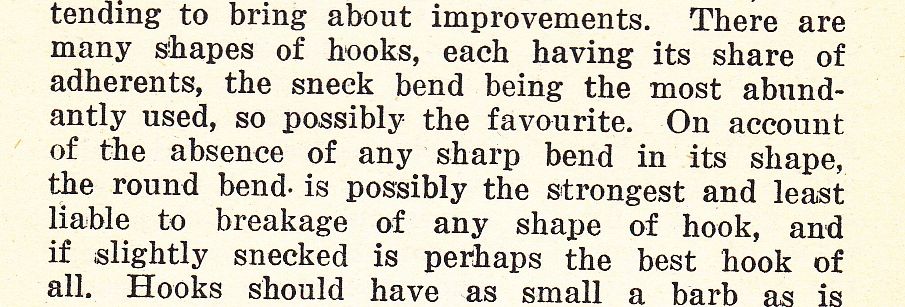
I also found in The flydressers Guide: The outpoint of "sneck" hooks turns to the right holding the eye of the hook towards you, while the outpoint of "reversed" hooks tuns to the left.
I think Skues uses a roundbend hook with or without a "sneck"in it.
greeting
Re: Leisenring's Orphan Nymphs
Posted: Mon Sep 02, 2013 7:31 am
by narcodog
A Sneck is the shape of the hook, like a perfect bend or sproat. When a hook is off set it is called a reverse. So the total nomenclature is reversed sneck bend. Now if it is bent latterly to the other direction it has another name which escapes me this early in the morning.
Re: Leisenring's Orphan Nymphs
Posted: Mon Sep 02, 2013 8:11 am
by Ruard
narcodog wrote:A Sneck is the shape of the hook, like a perfect bend or sproat. When a hook is off set it is called a reverse. So the total nomenclature is reversed sneck bend. Now if it is bent latterly to the other direction it has another name which escapes me this early in the morning.
Hi Narcodog,
I always thought that it was the way you say it. But John Veniard give also the meaning of the word sneck for:
The outpoint of "sneck" hooks turns to the right holding the eye of the hook towards you, while the outpoint of "reversed" hooks tuns to the left.
John Wooly described it as "slightly snecked" for a roundbend hook.
Greeting
Re: Leisenring's Orphan Nymphs
Posted: Mon Sep 02, 2013 8:41 am
by tie2fish
Tomayto/tomaato ... "offset" works fine

.
Re: Leisenring's Orphan Nymphs
Posted: Mon Sep 02, 2013 9:57 am
by narcodog
If you have access to Darrel Martins "Th Fly Fisher's Illustrated Dictionary" he has a very good although a some what confusing description of the sneck hook. It seems that there are several ways one can define a sneck. Some refer it to just the offset, while others to the bend it's self.
For me I'm gonna stick with the shape of the bend.
If John S. sees this he may be able to shed some light on the subject. He is the hook MAN.
Re: Leisenring's Orphan Nymphs
Posted: Mon Sep 02, 2013 10:14 am
by Old Hat
It appears there may be a morph of how the word "Sneck" is used today and yesterday.
Everyone I have known refers to "sneck" as the bend of the hook. A square bend. But if you read this quote by Skues posted by DD in the swap thread.
"My own beliefs is that wet flies tied on gut swim better and hook better than those tied on eyed hooks. As the drying action of casting is reduced to a minimum, they are not so ready to go at the neck as when used as dry flies; but if the angler prefers it, there is no reason why he should not use eyed hooks, though snecked bends of any kind and upturned hooks are deprecated. Down-eyed hooks, round, unsnecked square-bend, and Limerick, in that order named, are recommended".
I posed the question with not yet a response there. What is an unsnecked square-bend hook? This distinguishes the square bend from the "snecked" description and would possibly support Ruard's position.
Interesting.