Page 5 of 8
Re: Clark's dubbing block
Posted: Tue Jan 31, 2012 11:07 am
by gingerdun
I imagine one could use any textured material for the "sighter" pad as the idea behind it would be to help stop the dubbing adhere to any remnant wax as much as being the background of contrast?
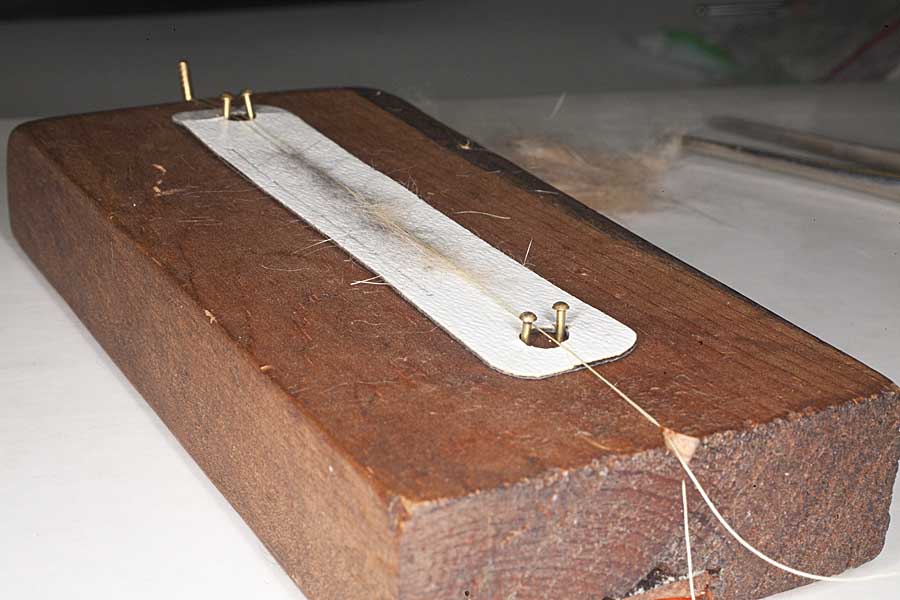
So the brass nails are fairly self explanatory, bu what is the chrome eschunion or upolstory pin for in the top of the block?
Personally, I find that the smooth white background is fine, even for the more transparent dubbing fibers. The black Naugahide on the other side has a rough fake leather texture that I find interferes with seeing the fine texture of the dubbing. I never use the black side. Perhaps a white stain on a light poplar or pine block would be good.
Now getting down to brass tacks

I am not sure how Pete used that big one on the end of the block. He may have looped the thread around it to measure two block-lengths of thread, which would have been roughly 10". I find that 11" is a better length, and then I trim off the extra after the finished body is notched securely in the card. That extra inch makes it easier for me to spin the loop after the dubbing has been applied on the thread. You can't see it in my photo, but on the other end, on the bottom, Pete cut out an area for inserting a half-inch razor blade to cut the thread lengths. IMHO, that is a lot of trouble for not much advantage.
Your photos of dubbing cards made me realize I can create some that are a lot sparser then anything I've created so far.
Wayenb, Yes some are amazingly sparse, but others not. He had a full spectrum for all sizes of hooks and patterns. But in general, they tend to be sparse, to make slender bodies, like the little bugs bodies. And he often tapered them, more slender at the tail, and thicker at the head. He didn't like the double-taper that got thinner at both ends. Neither did Leisenring.
Re: Clark's dubbing block
Posted: Tue Jan 31, 2012 11:23 am
by JohnP
Awesome stuff. Thanks so much for sharing.

Re: Clark's dubbing block
Posted: Tue Jan 31, 2012 11:45 am
by Ruard
Gingerdun thank you for sharing these pictures!!
Does anyone use the dubbingblock just in the opposite way? I mean the two lose ends on the side the most far away from you and the loop just in front of yourself.
This is the way I do it.
Greeting
Re: Clark's dubbing block
Posted: Tue Jan 31, 2012 12:50 pm
by gingerdun
OK, here are some more shots to explain how Pete Hidy used the Clark Spinning Block.
Re: Clark's dubbing block
Posted: Tue Jan 31, 2012 12:59 pm
by gingerdun
- Lay the other half of the silk over your carfully-placed dubbing and secure it in the notch with the other end of the thread. Note the little cutting blade that Pete inset into end of the block for cutting thread to the correct length.
- ClarkDubbing_4301Lo.jpg (77.7 KiB) Viewed 10213 times
Some more——
Re: Clark's dubbing block
Posted: Tue Jan 31, 2012 1:16 pm
by gingerdun
Here's the finished body, in detail. I blended the Hare's cheek and Muskrat right on the block, not in advance.
ABOUT THE WAX. Leisenring gives the recipe in Art of Tying the Wet Fly, page 8. He says it is an old recipe of J. Harrington Keene. In brief, the ingredients are one-half pound of the best white turpentine resin, one ounce of pure white beeswax, and one-half ounce of fresh lard. He would cut off pieces the size of BB shot. Pete would warm the wax up in his fingers, and soften it before sliding the Pearsall's silk through it. This would make the thread just a little tacky, enough to keep the dubbing from sliding, but not enough for the fibers to stick to it.
As I said before, silk is the best for these dubbing loops, because it will set overnight, and not un-twist when you remove it from the card to tie into the fly. Other threads don't hold the twist so well, even when waxed, and tend to unwind even days later.
Re: Clark's dubbing block
Posted: Tue Jan 31, 2012 1:18 pm
by daringduffer
In my dubbing block I have placed the brass nail where Pete has his big one. I have then made a notch in the exact center of the rounded end. This way the thread gets perfectly aligned and stays put in the notches in opposite ends. This also makes it easy to put the thread over the dubbing and lock it in both notches prior to starting spinning the silk
dd
Re: Clark's dubbing block
Posted: Tue Jan 31, 2012 1:31 pm
by gingerdun
DD, I like the sound of that. Makes sense. Probably healthy to experiment with design modifications to find what works best for you, since these are so ridiculously easy to build.
Gunnar Johnson wrote that he just used a square plate of glass, and laid the waxed silk directly on it. He didn't need the Clark Spinning Block.
Re: Clark's dubbing block
Posted: Tue Jan 31, 2012 2:08 pm
by JohnP
Best. Thread. Ever!
Re: Clark's dubbing block
Posted: Tue Jan 31, 2012 2:31 pm
by daringduffer
Anders Forsling, Gunnar's co-author ("Flymfer"), used the block with the silk on the bobbin holder. He put a piece of rubber tubing on the bobbin tube and made a notch in the rubber. When the dubbing was in place, he put the loose end of silk into that notch and twisted the bobbin holder hanging down from the block before he gently lifted it to let that twist run to the nail in the other end.
dd