I was sensing that Mark (willowhead) had a "itch" that wasn't getting "scratched". So I put on my thinking cap (in this case my magnifying glasses) and set to work on an experimental concept fly. Creativity and having fun were my goal. Okay, Mark. This fly is just for you. I give you:
Cotter-pin/Wiggle-Tail/Dubbing Brush/Triple-Hackled Golden Stonefly Flymph (
even the name is catchy, don't ya think?)
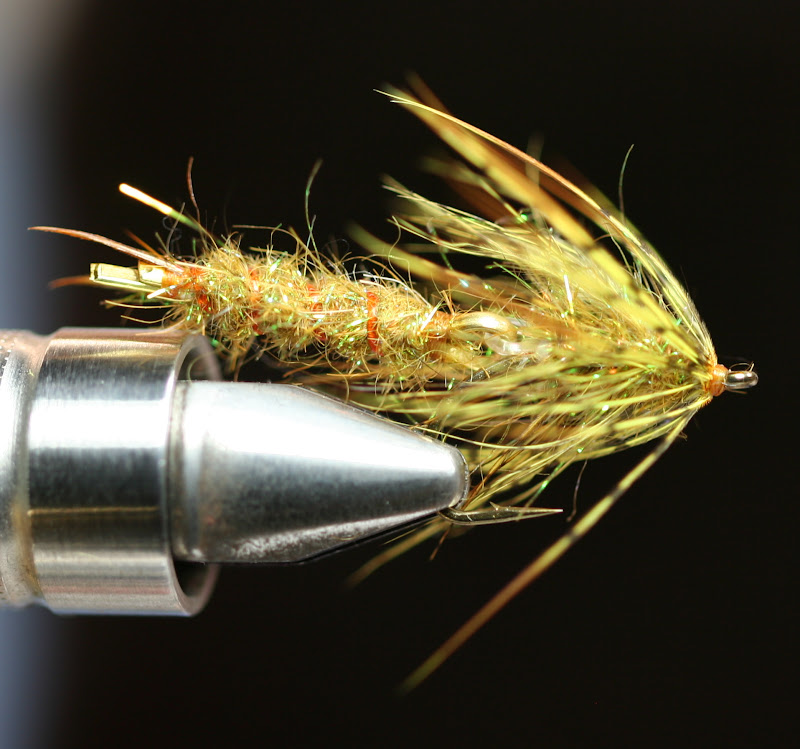
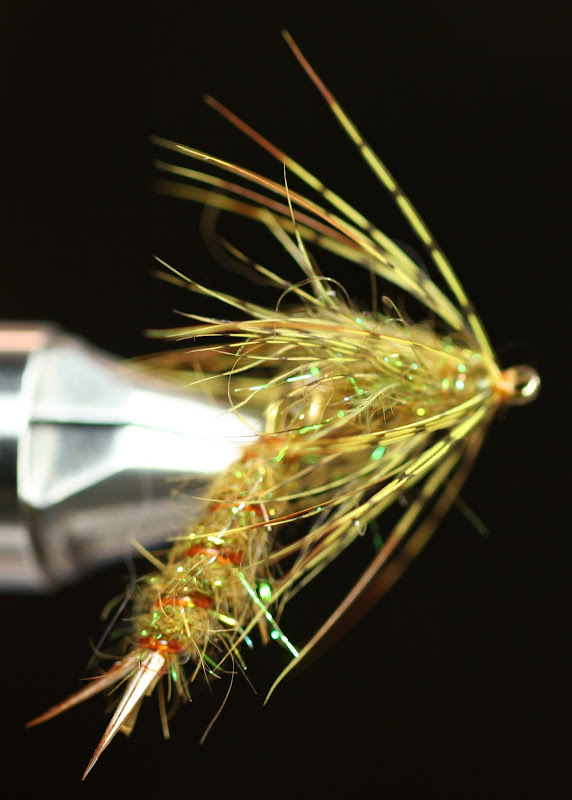 Pattern/Recipe
 (
to keep Hank happy - chuckle):
Wiggle Tail Core - Brass Cotter-pin (5/8" long)
Thread - 8/0 UNI-Thread (White)
Tail - Duck Biots (Colored with a Marigold Sharpie Marker)
Rib - UTC Vinyl Rib (Orange / Midge)
Abdomen - Wire Dubbing Brush (Golden Brown Hare's Ice Dubbing twisted in a copper wire dubbing brush)
Hook - Daiichi Model 1150 Curved Hook (Size 10)
Junction - loop of 20 pound test monofilament fishing line secured to the hook shank
Body - Wire Dubbing Brush (Golden Brown Hare's Ice Dubbing twisted in a copper wire dubbing brush)
Hackle - Three Hungarian Partridge (dyed picric yellow) - Three separate hackles, tyed in with only a single wrap at each location (split body in 1/3rds)
Head - Tying thread - 8/0 UNI-Thread (White) colored with a Sharpie Marker
I didn't have any Marigold color thread, so I used white and improvised with one of my Sharpie Markers.
The dubbing brush was inspired by Ruard's great copper-core flies.
I needed to counter rib over the dubbing brush to keep the rib from settling in to deeply between the wire. Counter ribbing kept the rib on the outer surface of the fly.
I left the butt end of the cotter-pin showing in the photos above. Once the fly is finished, the excess can be trimmed back with a pair of wire cutters.
I have been bouncing around the idea of a triple hackle flymph for a while. The idea is to simply build the fly from the back to the front, instead of wrapping a single hackle thru the body. For some reason, I have difficulty with the standard flymph hackling technique. The triple-hackle method involves bulding a dubbing lump at the back of the body, then tying in a hackle feather by the stem, make one single wrap of hackle, tye it off and clip off the excess. Then dub another third of the body, tye in a second feather, make one wrap of hackle, tye it off and trim excess. Dub the front third of the body, tye in the collar hackle (longer), make another wrap or two (whatever makes you happy) and then secure the hackle, trim excess and whipfinish a head. Anyway, this fly gave me a chance to try out the idea. I kinda like the results, although it takes a lot more steps to get similar results. Just another way to skin a cat...
This is intended to be a concept fly. Just a bunch of different ideas thrown together to see if any of them have merit. I think with a little fine tuning, this could be a useful fishing fly.
Constructive feedback is welcome (good/bad/or otherwise). Feel free to pick the fly, and the ideas, apart. Alrighty then!
 ............
  ............WAIT! i know what we do.........when it has a wing........you simply call it, a "Flyin' Flymph."


